Relics, Desire and the Search for Awe: A Conversation with Elina Pasok
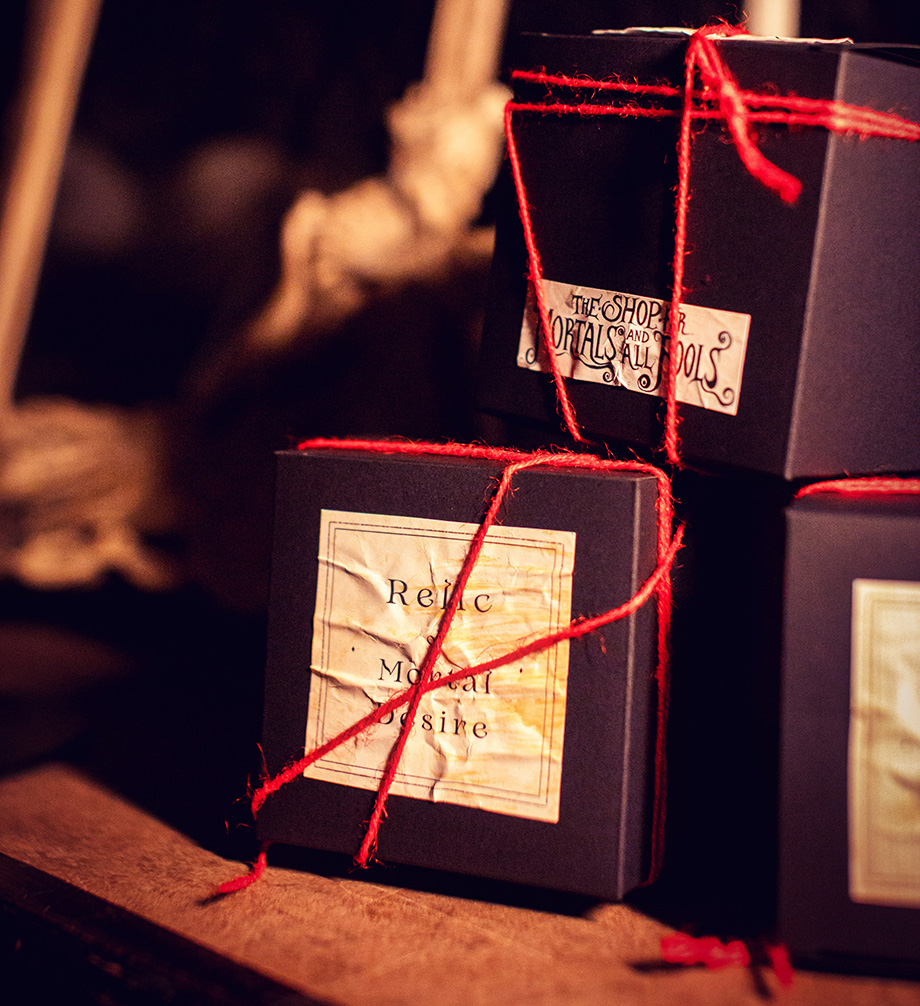
As part of the development of The Shop for Mortals and All Fools, I sat down with artist Elina Patak to talk about her work, the Relics of Mortal Desire blind boxes she created for the show, and the stories we attach to objects.
One of the things that struck me most was how often our conversation returned to the idea of healing.
Elina described a painting she made while recovering from a deep cut on her hand. As she healed, she embroidered red thread into the painting, each stitch becoming a blood vessel. By the time the work was finished, her hand had healed too. The painting became not just an image, but a record of recovery.
That immediately resonated with me because The Shop for Mortals and All Fools is also about retelling. The central character revisits the same story again and again, and through that process slowly heals herself. It reminded me that sometimes we tell stories not to remember the past, but to survive it.
The conversation then moved to the Relics of Mortal Desire. Inspired by ancient votive offerings, the blind boxes contain small handmade relics that are deliberately open to interpretation.
In ancient times people would offer objects to the gods in exchange for healing, fertility, protection or good fortune. What fascinated Elina was how different our desires have become. Today we search for things that are harder to name: belonging, courage, connection and purpose.
One of my favourite moments in the interview came when she said, “We have dreams that are not ours.”
It’s a simple sentence, but it stayed with me. How many of our desires are truly our own? How many have been inherited from family, culture or expectation?
The relics don’t provide answers. Instead they invite curiosity.
Each relic contains what Elina calls a “breath” of the natural world. Some contain twigs, some thread, and some even contain ash made from handwritten blessings that were burned and incorporated into the objects. The idea that luck, hope and intention could become part of the material itself felt both ancient and strangely contemporary.
Towards the end of our conversation, I asked Elina what she would put inside a box representing her own deepest desire.
Her answer wasn’t an object.
It was awe.
Those rare moments when something unexpectedly moves us. A painting, a performance, a conversation or an encounter that shifts our perspective and stays with us long after the moment has passed.
Listening to her, I realised that this is what connects her work to the world of the shop. Neither is really about objects. Both are about meaning. About the stories we carry. About the things we cannot quite hold but continue searching for anyway.
And perhaps that is what makes a relic valuable in the first place.